Key takeaways
- Technology is no longer a business function. It drives how organisations function.
- AI is expanding the CTO’s remit.
- Strategic judgement matters more than ever.
- Technology leaders need to understand where AI can add value, where people are better placed and which problems are worth solving.
- People’s capabilities need to evolve alongside AI.
AI is changing what technology leaders do. Not just the job, but the remit.
Traditionally, CTOs, heads of IT, and engineering directors have been responsible for the stack: the software and infrastructure, and the plan for how it gets built and rolled out. The rest, meaning how the organisation worked and who did the work, usually sat with HR or the COO. AI has blurred that line.
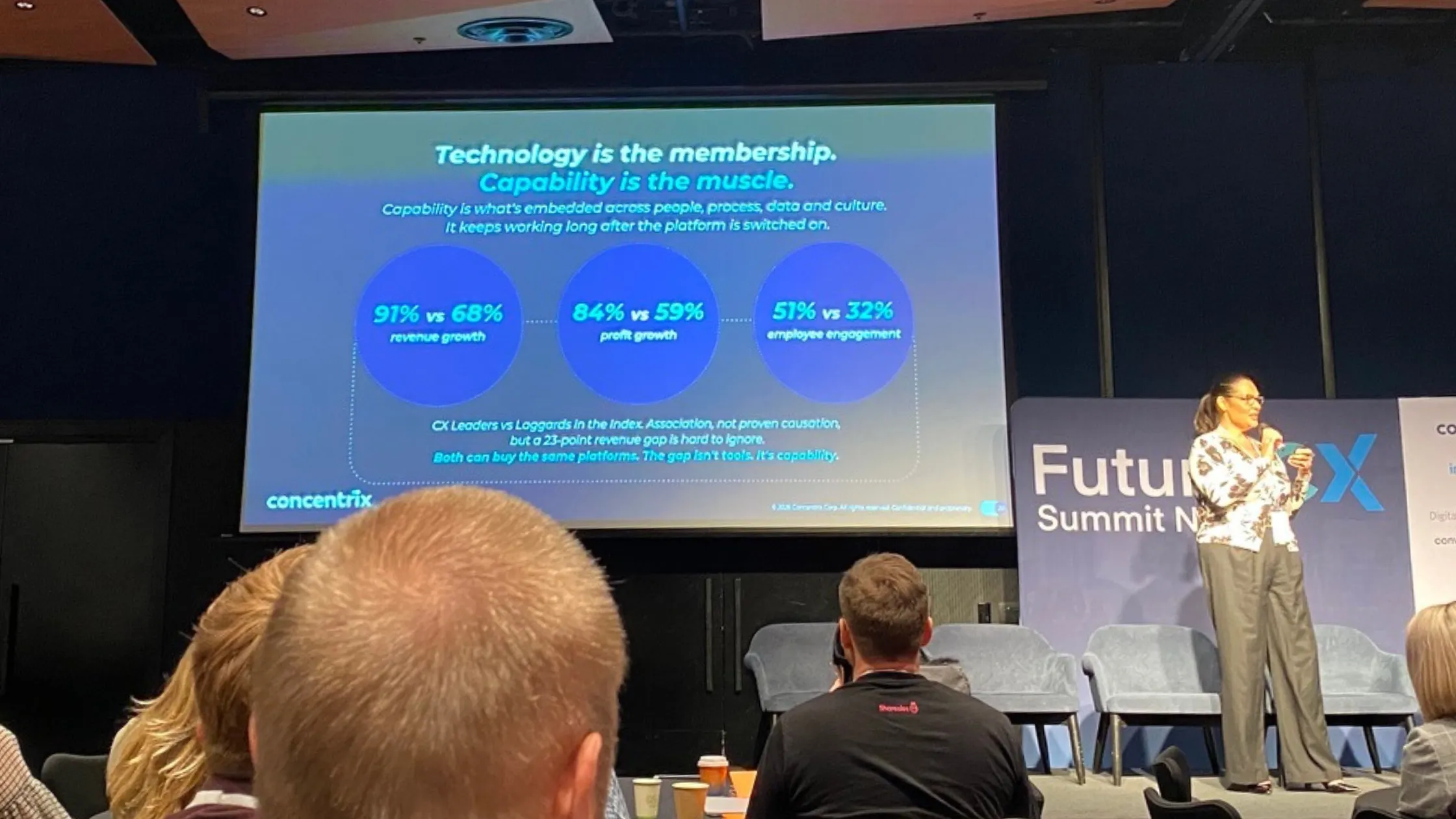
This shift ran through the conversations and talks at the Future CX Summit: AI is asking CTOs to step into a mandate of a different size and flavour, one most have no deep expertise in.
Getting value from AI now depends on two things. First, organisational maturity: streamlined systems, consistent standards, and clean data. Second, human discernment (at every level of the organisation): knowing where and how AI is best placed to support the work, and how to keep critical thinking sharp as AI takes over more of the tasks that used to hone it.
With adoption largely table stakes, executives are facing a cross-functional dilemma. Organisational performance no longer divides neatly into business functions.
A share of the COO’s job
Gartner predicted that, through 2026, organisations will abandon 60% of AI projects that aren’t supported by AI-ready data. The constraint isn’t the model. It’s whether the information underneath it is captured, structured and maintained well enough to use.
That is a question about how people work. It’s also why whoever leads an AI initiative will end up with a share of the COO’s job.
If an AI initiative depends on standardised processes, whoever leads it is now in the business of standardising those processes. If it depends on legible data, they’re in the business of how people capture and maintain that information. If it depends on how decisions are made, they’re in the business of decision rights. That is operating model territory: ways of working, rhythm, culture. And it doesn’t end at go-live.
In 2026 reserch by Concentrix, 98% of New Zealand businesses reported barriers to scaling AI. Sixty-six per cent said they were stuck in the early pilot stage. The barriers they cited: implementation costs, skills shortages, disconnected proofs of concept and fragmented data.
Strip away the cost, and most of what’s left isn’t a technology problem. It’s a question of how the organisation works, which is the COO’s territory. Yet Concentrix found only 10% of AI use cases sit in the back office, where most decisions are made.
Decision altitude
Adoption can be mandated, but discernment cannot. It’s required of everyone, at every level of what I call decision altitude: from individual roles to the organisation as a whole. The more complex the inputs, the higher the altitude.
Within a role, it means looking at your own work, identifying where AI would make a meaningful difference, then deciding whether that’s best solved with a colleague, with AI, or not at all. It asks people to become designers of their own work.
Across the organisation, it means seeing beyond individual AI applications to where technology, people and business strategy intersect: which problems are worth solving, where AI will make a difference, and where investment in people or process changes will deliver more value.
Critical thinking still needs to be practised
The second part of discernment is one we’re not yet discussing seriously. The work AI now takes over, drafting, analysing and synthesising, is the work that used to make people think.
Researchers from Microsoft and Carnegie Mellon surveyed 319 knowledge workers who use generative AI weekly. The more people trusted AI’s output, the less critical thinking they applied. The more they trusted their own expertise, the more they applied.
That trust in their own expertise now has to be built deliberately, because AI is absorbing the work that used to build it. It’s built in how work is designed, how decisions are reviewed, and what people are expected to challenge.
Critical thinking won’t survive on a training calendar. It survives in the design of the work, which makes it a leadership decision every time a task moves to AI.
What it asks of executives
The CTO’s shifting role is a signal. AI is blurring the boundaries between functions, and it isn’t only redefining work. It’s redefining the system work runs on: the operating model that turns investment into value, again and again.
The question for executives is whether the operating model on paper still matches how work and decisions now move. When there’s a gap, leaders make decisions on outdated data. Investment goes into a future the organisation can’t hold, and each misjudged call weakens the operations it was meant to improve. That costs money, and credibility.
Three signs the gap is already costing you:
- Strategy is agreed at the top, but each function executes its own version
- Teams put in the hours, but the work still falls short of what it needs to be
- Work gets duplicated, in parallel processes or in systems that don’t connect
If you’re seeing these, let’s talk. Book a clarity call with our CEO, Sarah Clearwater, to find out more.